
Leaf cleanup is a small job until it is not. A few settled leaves on a step are easy. A pool floor covered in wet, packed leaves is a different task. The three picks below cover three different ways to handle the easy end of that range.
Two are cordless handheld vacuums with their own debris bag. One is a manual hose kit that runs off an existing above ground pump and filter. None of them is proven for storm mats, so each section marks its limits.
1. Pool Blaster Max cordless handheld vacuum

POOL BLASTER Max POOL BLASTER Max
Our verdict:
Controlled spot pickup
For local settled debris when you want a handheld collector rather than a suction hose.
View on Amazon- Cordless handheld vacuum with its own reusable bag
- Catalog supports soft-sided and steel-sided above-ground pools
- Catalog lists up to 60 minutes of battery power
Keep in mind: Hands-on work and bag care remain. No exact fine-particle capture grade is established. Confirm the supplied version, pole and contents.
What this listing covers
The Max Li is a battery-powered handheld vacuum. It has a 10.5-inch rotating head and a reusable filter bag. Water Tech's Max Li (Gen 2) page lists a push-button switch and a lithium-ion battery. It also lists an upper runtime of 60 minutes.
One scope note matters here. The selected retail listing does not confirm which maker SKU it matches. Its feature set lines up with the current Gen 2 page.
We use only shared, supported features here. The exact listing-to-SKU identity remains unconfirmed. Older Max versions are a separate item, and their specs should not be assumed to match.
Where it helps with leaves
This is a cleanup tool for settled leaves. Think of a floor that has collected a light layer after a windy week. The maker names leaves, pine needles and acorns in its debris list. It also names sand, silt and pollen.
The head is wide for a handheld at 10.5 inches. That means fewer passes over a flat area. It also pivots, which the maker says helps it follow the surface. That is a design claim, and we did not test it.
How the debris is handled
Debris goes into the vacuum's own reusable filter bag. It does not travel through your pump and filter. That matters most when your filter is already near its limit. A pool with fine silt and leaf bits may stress a small cartridge.
Keep one point clear. Trapping debris in a bag removes it from the pool. It does not sanitize the water. Chlorine or another sanitizer still does that job, so water balance stays a separate task.
Reach and pole fit
The maker says the vacuum attaches to any standard telescopic pole. The includes list names the bag, head, crevice nozzle and chargers. It does not name a pole. Plan to own one, or buy one separately.
The listing says the pool types it suits include inground, steel-sided and soft-sided above ground pools. It also says swim spas. A pole length is the real fit question. A deep inground floor needs a longer pole than a small round pool does.
Remaining manual work
Every stop to empty the bag is manual. A bag holds a limited amount. Wet leaves pack down, and the bag can fill faster than you expect. The listing gives a chamber size, but we do not compare it with other models here. Capacity is not verified across these picks, so judge it by how your leaves behave.
Large leaves can also block the intake by lying flat across it. You may need to lift them clear by hand. The maker does not promise that every acorn or twig will go through.
Runtime is a ceiling
The 60-minute figure is an upper limit on battery time. It is not a measure of how much pool it covers. Suction load, leaf volume and head contact all change how long a session feels. A full floor of heavy debris may take more than one charge. A light debris load still does not establish how many charges your job will need.
Who should consider it
This fits an owner with a modest pool and light, steady leaf fall. It also fits someone who already has a robot cleaner and wants a tool for what the robot leaves behind. The maker pitches it that way.
It makes less sense if you want a hands-off machine. It also makes less sense after a storm. In that case, net the bulk first and vacuum what remains.
Reasons to keep your existing gear
If you own a working robotic cleaner and a skimmer net, you may not need this. A net removes floating leaves faster than any vacuum does. A robot can handle a settled floor on a schedule. The Max Li earns its place only if you have steps, corners or ledges that those tools miss.
If a robot is on your list, see our robotic pool cleaner guides. For other handheld options, our handheld pool vacuum roundup compares more models.
2. Pool Blaster Centennial cordless pool vacuum with pole

POOL BLASTER Centennial POOL BLASTER Centennial
Our verdict:
Sectional pole included
A guided cordless option for routine settled debris with the selected package's sectional pole.
View on Amazon- Own debris chamber and reusable filter
- Published runtime: up to 45 minutes
- Selected catalog includes a four-piece pole
Keep in mind: The sectional pole is not a full telescopic pole. This listing is for weekly upkeep, not a promise of heavy opening-debris pickup.
What this listing covers
The Centennial is also a cordless handheld. The selected listing pairs it with a pole. Water Tech's Centennial page describes the current model with a 10.5-inch head and a lithium-ion battery. It states an upper runtime of up to 45 minutes.
The maker page shows two SKU numbers in different places. One is in the header and another is in the spec list. Confirm the exact pack before you order. Do not assume details from other Pool Blaster models carry over.
The pole situation
The maker lists a four-piece sectional pole of 45 inches. It also lists a pole adapter. The page adds that a telescopic pole is not included. The selected catalog listing also names the four-piece pole.
How it handles leaves
The maker describes a cone filter and an extra-large debris chamber. It names leaves, twigs, acorns, dirt, sand and silt as targets. The catalog copy adds a limit. It says the vacuum suits weekly upkeep and is not meant for a full pool opening with heavy debris.
That limit is the most useful sentence on the page. It tells you where the tool stops. A spring opening full of soaked leaves needs a net, a rake or a different tool first.
Quick-release emptying
The chamber detaches with a dual-cam lever. You release it, dump it and rinse it. That sounds simple, and it is a real advantage for leaves. Leaf pickup means many short emptying stops, so an easy release matters.
Rinsing is still on you. Fine silt can cling inside a bag. Plan to clean the filter bag so water flows through it freely.
Heads and attachments
The head is 10.5 inches wide with a soft-bristle brush. The maker says it can be removed to expose an angled head for tight spots. A crevice nozzle and scrubbing brushes are listed. These help on steps, corners and sun shelves.
Surface types
The catalog says it suits vinyl, fiberglass, concrete and inflatable pools, in salt or chlorine water. Treat that as a catalog compatibility claim. It is not a guarantee against scuffs on every liner. Check the exact manual for care notes on your surface.
Care burden
Charging takes about four hours by the maker's account. That means a session today can leave the unit idle tomorrow. If you clean in short bursts, this is fine. If you want back-to-back sessions, plan for the downtime.
Use the exact manual for filter care, charging and storage. Match the specified charger and charging location to the unit.
Runtime is a ceiling here too
The 45-minute number is an upper figure. It does not tell you how much pool you can clean. Heavy leaf loads slow the work and fill the chamber. You may spend more time emptying than vacuuming.
Who should consider it
This suits an above ground pool owner who wants a pole in the box. It also suits someone with mixed debris: leaves, a few twigs and some silt. The quick-release chamber matches that pattern.
It is a weaker fit for a large inground pool with deep ends. The included pole is short, and you would add a longer one. It is also a weak fit for a pool under a big tree in fall. There, the floor can fill faster than a handheld can keep up.
Reasons to keep existing gear
If your pool already has a filter that copes well with fine debris, the bag benefit shrinks. If you own a long pole and a manual head, you may only need a net. If your problem is mostly floating leaves, a skimmer net is faster than a vacuum. Our manual pool vacuum guide covers that corded route in more depth.
3. Intex Deluxe Above Ground Pool Maintenance Kit with Vacuum (28003E)
Intex Deluxe Maintenance Kit / 28003E Intex Deluxe Maintenance Kit / 28003E
Our verdict:
Hands-on Intex kit
Compare the complete tool kit when its listed Intex pool, pump and connection fit and you need the separate vacuum, net and brush tasks.
View on Amazon- Manual vacuum, net, brush, pole and hose listed
- Maker minimum pump rating: 800 GPH
- Maker recommends pools 18 feet across and larger
Keep in mind: No pump or filter included. Confirm the exact package and connection; pole-length wording differs within the catalog. The tools do separate jobs and do not sanitize water.
A different kind of tool
This is not a battery vacuum. It is a manual kit. The vacuum runs off your pool's filter pump through a hose. Intex's maintenance kit page is the maker source for the pack.
The kit works only with a compatible Intex filter pump. The listing states a minimum flow rate of 800 gallons per hour. That is a maker requirement for the pump. It is not a measure of the flow you will get once the hose is attached.
What is in the kit
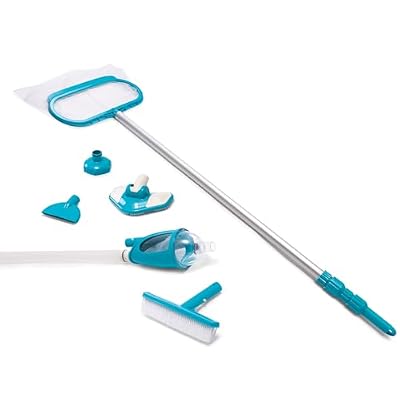
The listing names these parts:
- A leaf rake with a debris net
- A curved wall brush
- A deluxe vacuum head with two nozzles
- A scrubber vacuum
- A telescoping aluminum pole
- A 24-foot hose with connectors
The listing leaves the exact pole length unsettled. Verify the supplied pole and its reach. The maker describes this kit for pools of 18 feet in diameter and above.
Why the leaf rake matters
The rake and net come in the kit. For leaves, that is the best part. Surface leaves and big mats are a net job. You remove them before any vacuum touches the water.
That order protects your filter. A vacuum pulling in soaked leaves can clog a small filter basket or cartridge. Net first, then vacuum what has sunk.
How the debris is handled
Here the debris goes through your pump and filter. That is the main contrast with the handhelds above. The filter holds the debris, so it will fill sooner. Cleaning or changing the filter is part of the job.
This can be fine if your filter is sized well and you clean it on time. It can be a burden if your filter is small. Our above ground pool filter guides help with sizing. The pump guides cover the flow side.
Remember that catching debris in a filter is not sanitizing water. The filter holds particles. Your sanitizer still handles germs and algae.
The pump fit question
This is where the kit can fail you. If your pump is not a compatible Intex unit, or it falls under the stated minimum, the kit may not work as intended. The 800 gallons per hour figure is a floor set by the maker. A pump label or rating does not prove the flow at your pool, once hoses and a dirty filter are in the path.
Read the pump and kit manuals before you buy. They govern the connection steps, and this article does not give them. Our Intex vacuuming walkthrough and Intex vacuum overview cover more of the Intex route.
Where it fits for leaves
It fits a mid-size to large Intex-style above ground pool. It suits an owner who already has a compatible pump and filter. That owner pays nothing extra for power, bags or batteries, because the system is already there.
It handles settled leaves and some grit. It is not a robot. You walk the pole around the pool, and you stay with it for the whole job. Nothing about it is automatic.
Remaining manual work
Netting floating leaves remains separate. Guiding the head along the floor is hands-on work. The filter and baskets also need care. You may also scrub walls with the brush.
For algae, this kit is a partial answer. The brush and scrubber head are described for walls. Algae treatment is a water care task, not a vacuum task. Our above ground algae vacuum guide covers that case.
Care burden
Hoses and heads need rinsing and drying. The pole needs to stay clear of sand. A hose that kinks or leaks reduces suction. This is a matter of tidy storage more than anything technical.
Who should consider it
Pick this if you want one pack of basic tools for a larger above ground pool. It is also a fair pick if you do not want to charge or empty a battery unit. It suits the owner who prefers a hose and pole to a bag.
Skip it if your pump is not compatible. Skip it if your pool is small, since the 18-foot guidance leaves it out. And skip it if your filter is already struggling.
Reasons to keep existing gear
If you already own a working pole, hose and vacuum head, this kit duplicates them. A spare rake or net may be the only useful add. If your pump fits a different brand's vacuum head, check that route first. A suction-side cleaner may also fit a pool that needs hands-off help.
Factors to consider when choosing best pool vacuum for leaves
Match the tool to the leaf load
Light, settled leaves are the only job these picks are written for. A handful on a step needs a handheld at most. A thick mat on the floor needs a net or rake first. A full fall season may need a robot or a pump-fed system.
Ask yourself how many leaves land each week. If the answer is "a few," a handheld is enough. If it is "a lot," plan for bulk removal before any vacuum.
Self-contained or pump-fed
A handheld carries its own bag. A manual kit sends debris through your pump and filter. Each choice moves the work somewhere else.
With a handheld, the work is emptying the bag. With a kit, the work is cleaning the filter. Pick the chore you mind less.
Pool size and depth
Runtime and what it means
Stated runtime is a ceiling. Both handhelds give an "up to" figure. It does not show how much floor area you can clean in one session.
Treat the number as a rough guide to battery size. Then ask how long you really clean. Short sessions fit a handheld well.
Emptying frequency
Wet leaves fill a bag fast. A quick-release chamber helps. A large chamber helps more, but we do not compare sizes across these models.
If you dislike emptying often, a pump-fed kit or a robot may suit you better. Those move the debris to a larger filter basket or a bigger onboard bin.
Pump and filter health
A hose kit loads your filter. A weak filter plus heavy leaves is a poor mix. Check that your pump meets the maker's stated minimum. Remember that the listed minimum is not measured installed flow.
If you are not sure, the pump manual and a pool store can help. Our pool pump calculator guide may also help you think through sizing.
Pole needs
None of these picks guarantees a pole that fits your pool. The Max Li lists none. The Centennial includes a short sectional one. The Intex kit includes a telescoping pole of uncertain length. Decide what reach you need before you buy.
Surface and liner care
Brushes and heads touch your liner or floor. Follow each manual for care notes. A soft liner and a hard concrete floor do not take the same contact.
Leaves versus algae
Brown leaves and green algae are different problems. A vacuum removes leaves. Algae is living growth and needs water care. Do not expect a leaf vacuum to fix a green pool.
Keep what you have
A good net, a working robot and a clean filter solve many leaf problems. Buy a new tool only for a job your current gear misses. That is the cleanest rule in this guide.
How We Picked
This is specification-based editorial work. We did not test these products or time them in a pool. Suction, pickup and battery life were not measured. The comparison uses documented features and their limits.
We read the maker pages and the retail listing details for each model. We checked them on October 16, 2026. We kept each exact model separate and did not carry specs from other versions.
We looked for a clear leaf job. We looked at debris handling, reach, depth limits, pole fit and care burden. We also looked at what each tool leaves for you to do by hand.
Where the maker page and the listing differed, we said so. That applies to the Centennial SKU numbers and the Intex pole length. We also noted that the Max Li listing does not confirm its SKU.
We did not use claims about price, warranty, durability or energy savings. We did not use customer opinions. A listing in a catalog does not prove a maker still produces the item.
These three picks are not ranked against each other. They are three ways to handle light leaf cleanup.
Leaves, algae and clean water are separate jobs
Leaves are the visible part of the problem. They block intakes, stain surfaces and feed algae as they break down. Removing them early helps, but the vacuum is only one step.
Floating leaves come first. A skimmer net is faster than any vacuum for those. Heavy mats come next, and a rake or large net suits them. Vacuuming is for what has settled.
Water care is separate. Filtering and removing debris do not sanitize water. Chemistry stays its own job, and your test kit and manuals guide it.
If your floor also has sand or grit, see our sand vacuum guide. If you want help picking heads or hoses for a manual setup, our vacuum head guide and vacuum hose guide cover those parts. For the general method, start at our how to vacuum a pool guide.
One last point on timing. Leaves are easier to lift while they are fresh. Soaked leaves clump and tear. A short weekly pass beats one big cleanup.
Our verdict on best pool vacuum for leaves
For best pool vacuum for leaves, documented fit comes before convenience. There is no single winner for every pool. The right pick depends on your pump, your pool size and your leaf load.
Choose the Pool Blaster Centennial if you want a handheld with a pole in the box for a small to mid-size above ground pool. Its own maker note says it is for weekly upkeep, not heavy openings.
Choose the Pool Blaster Max Li (Gen 2) if you want a wide head and a longer stated runtime. Bring your own pole. Confirm the exact model, since the listing does not name its SKU.
Choose the Intex maintenance kit only if you have a compatible Intex pump and a larger above ground pool. Verify the pump minimum and the pole length first.
For storm debris, net the bulk first. For a green pool, treat the water. If your current net, robot and filter already cope, keep them.
Frequently asked questions
Can a handheld vacuum clear a pool full of leaves?
Not well. Handhelds suit light, settled leaves and spot jobs. A pool full of wet leaves needs a net or rake first. Then a handheld can lift what remains. The Centennial maker notes say it is for weekly upkeep and not heavy pool openings.
Should I net leaves before I vacuum?
Yes, in most cases. Floating and bulk leaves come out faster with a net or rake. That keeps bags, hoses and filter baskets from clogging. Vacuuming then handles what has sunk. This order protects both a handheld bag and a pump-fed filter.
Does a battery runtime of 45 or 60 minutes mean full pool coverage?
No. Those are upper limits on battery time. They do not show how much floor you can clean.
Leaf volume, wet debris and frequent emptying all cut into real working time. Pool size and head contact matter too. Treat the figure as a rough battery guide only.
Will the Intex kit work with any pump?
No. The listing says it needs an Intex filter pump with a minimum flow rate of 800 gallons per hour. That is a maker requirement for the pump. It does not tell you the flow at your pool. Check your pump and kit manuals before you buy.